


Concepcion, 22 December 2025
UdeC Astronomy Academic Leads Publication That Brings Together All the Knowledge Accumulated About the Beginning of the Universe
The publication was released today in the prestigious journal Nature Astronomy. It brings together the main advances achieved thanks to the combined capabilities of ALMA and the James Webb Space Telescope, revealing that the first galaxies and black holes formed earlier and faster than previously expected, and highlighting the leading role that Chile will play in the coming decades.
The international team was led by Rodrigo Herrera-Camus, academic at the University of Concepcion (UdeC) and director of the Millennium Nucleus of Galaxies (MINGAL). The work integrates the most significant results obtained over the past three years from joint observations with the ALMA observatory, located in northern Chile, and the James Webb Space Telescope (JWST).
“This is a beautiful achievement, not only because of its promising content, but also because Nature Astronomy invited us to write this article, which is a true recognition that we are leaders in the field. This is not only about what our team has learned from its research; it is a paper about what the global astronomical community has learned about the early Universe. That is extremely rare. It is a great honour,” says the UdeC astronomer.
Treasure of the sky
Thanks to the combination of data from these two giants, ALMA and JWST, Herrera notes that the study of galaxies observed between 300 and 800 million years after the Big Bang, the “childhood” of the Universe, has undergone a profound transformation. “We now know that galaxies and their associated supermassive black holes emerged much earlier in cosmic history than classical models predicted.”
Before these instruments existed, research on distant galaxies relied mainly on ultraviolet observations and global estimates of mass and star formation, with very limited information on gas and dust. Today, it is possible to observe cold gas, dust, and stars on scales comparable to those studied in nearby galaxies, revealing that early evolution was faster, more complex, and more diverse than expected.
“In both abundance and size, these first galaxies appeared and grew much faster than our simulations could explain. It has truly revolutionised our understanding of how galaxies like the Milky Way formed so early,” explains Herrera-Camus. Among the main findings is the rapid appearance of interstellar dust and of chemical elements such as carbon, nitrogen, and oxygen in the very first stages of these systems.
The work also documents the detection of well-organised galactic discs at extremely early times, challenging the idea that such structures formed slowly and gradually. Added to this is the identification of “baby” supermassive black holes, some without a clearly visible host galaxy, as well as powerful galactic winds capable of expelling gas and regulating star formation from very early stages.
Stronger Together
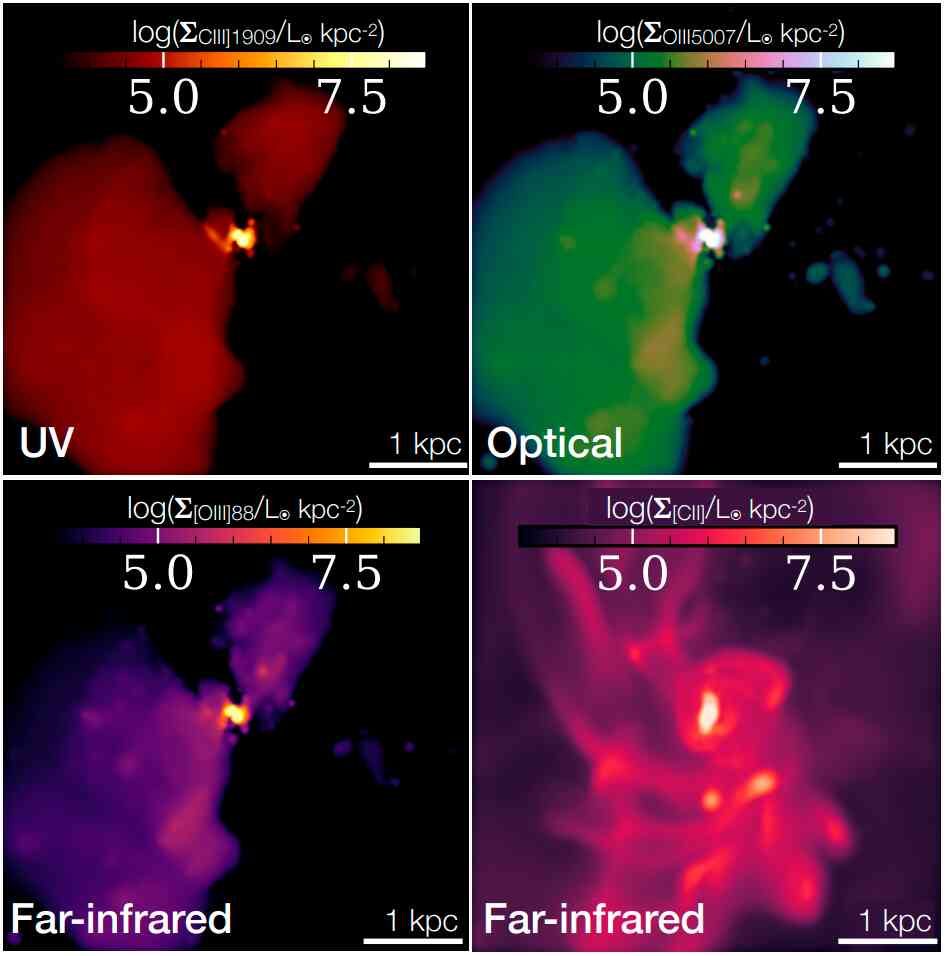
“This article presents an integrated view of the early Universe, bringing together the most relevant research worldwide to build a coherent picture of how the first galaxies formed, how they became enriched with metals, how the first discs were born, and how the first black holes grew,” says the researcher, who is also part of the Center for Astrophysics and Related Technologies – CATA (ANID Basal Centre). According to the astronomer, this article becomes a key and up-to-date reference for the field.
The paper draws on ALMA observations, which trace the early interstellar medium through atomic lines such as [CII] and [OIII], and on JWST data obtained with instruments including NIRCam, NIRSpec, and MIRI. These results are complemented by advanced cosmological simulations and sophisticated spectroscopic and energy-modelling techniques, also projecting the crucial future role of the Extremely Large Telescope (ELT) in deepening these studies.
The work highlights the leading role that Chile will play in the study of the early Universe thanks to the forthcoming operation of the ELT which, in combination with ALMA, will reveal with unprecedented detail how the first galaxies formed. It is also the result of more than a year and a half of work, originating in the international workshop “Synergistic ALMA+JWST View of the Early Universe”, held in December 2024 at the Lorentz Center in Leiden, the Netherlands.
The study, entitled “The early Universe with JWST and ALMA”, was written by Rodrigo Herrera-Camus together with Natascha M. Förster Schreiber (Max Planck Institute for Extraterrestrial Physics), Livia Vallini (Istituto Nazionale di Astrofisica), Rychard Bouwens (Leiden Observatory, Leiden University), and John D. Silverman (Kavli Institute for the Physics and Mathematics of the Universe, University of Tokyo). The article can be accessed at the following link: article
Millennium Nucleus MINGAL